
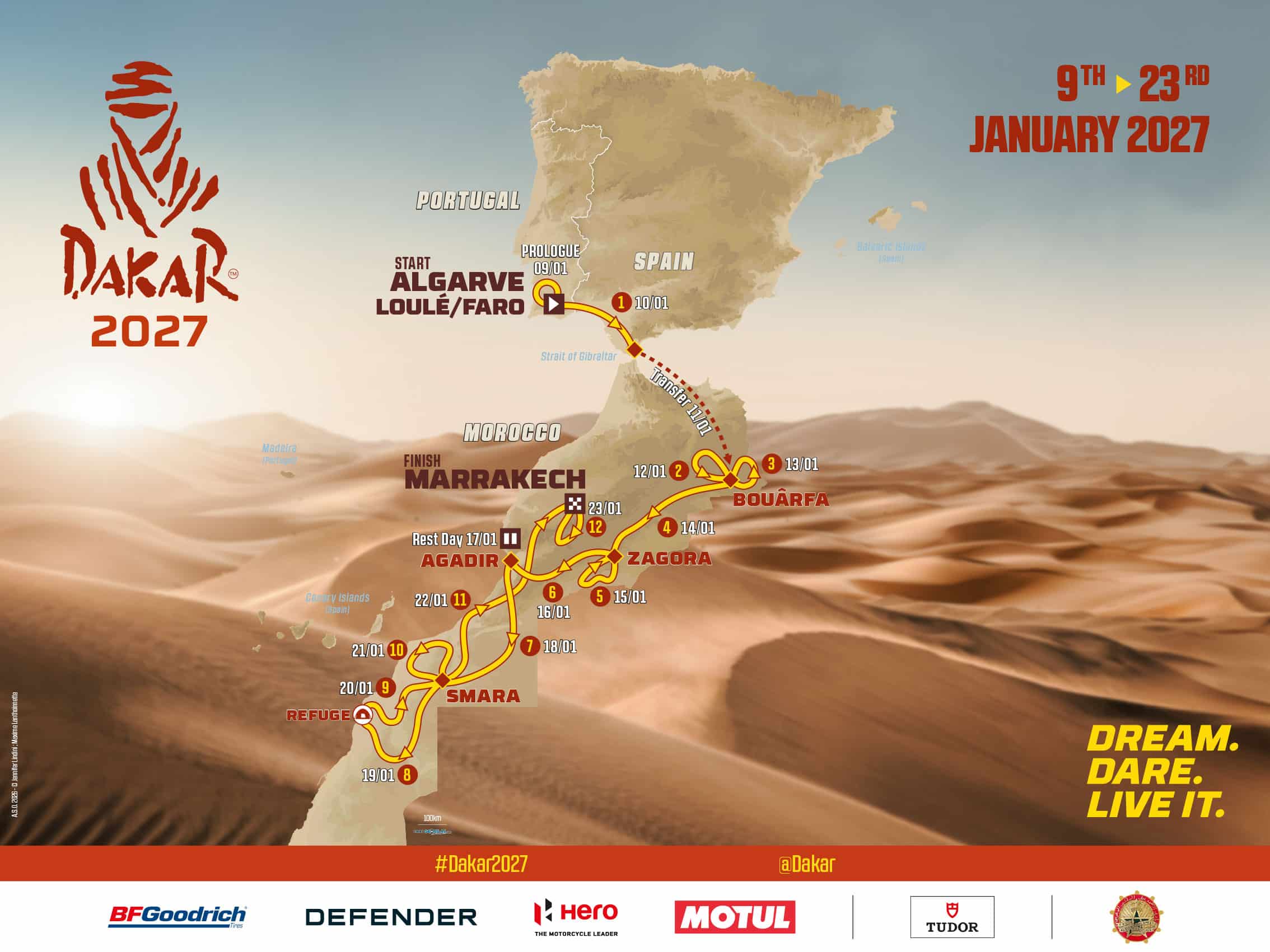
Just days after the decision not to hold the Dakar 2027 in Saudi Arabia for safety reasons, organizer ASO presented the new route. The 49th edition runs from 9 to 23 January through Portugal and Morocco. Despite the short preparation time, they managed to assemble a rally with 7.824 total kilometres (4.341 competitive kilometres) and twelve stages.
The start takes place on Portugal's Algarve. At the Loulé-Faro stadium, which has room for around 30.000 spectators, the service park and scrutineering will first be set up. On 9 January the sporting part begins with the prologue; a day later the first special stage on Portuguese soil takes place.
After that the entire Dakar caravan goes to the port, from where the competitors will cross overnight by ferry to Nador in Morocco. On 11 January a liaison takes them to the first African bivouac in Bouarfa.
Across Morocco to the Westsahara
From there the rally heads for the southern foothills of the Atlas Mountains. Via Zagora the route first leads to Agadir, where a rest day is planned. After that the second half of the event begins, which goes deep into the southern desert regions.
The route extends into the Morocco-controlled Westsahara via Smara and almost as far as Dakhla. Afterwards it returns via Smara to the north and follows the Atlantic coast to the finish in Marrakesch.
In total six different bivouacs are planned. Eleven of the twelve stages will be held on African soil. Most special stages are planned to be between 350 and 500 kilometres long. That keeps the Dakar, despite the short relocation, one of the toughest challenges in international motorsport.
"Despite the short time available to us, we have designed a real Dakar," explains Rally Director David Castera. He promises an uncompromising event with a route that goes well beyond the previous rally-raid formats in Morocco.
Return to Africa after 20 years
For the Dakar the decision means a return to its historical roots. The last time the desert classic was held in Africa was in 2007. The 2008 edition planned to start in Lisbon had to be cancelled at short notice because of security concerns. Afterwards the rally moved to South America, before Saudi Arabia became the host in 2020.
The renewed change presents the organizers with significant logistical challenges. Within a few weeks routes had to be reconnoitred, accommodations and bivouacs planned, and the necessary transport and security concepts adapted.
Castera nevertheless sees the event as well prepared. The Portuguese automobile club ACP is supporting the organisation of the start, while ASO in Morocco can rely on long-standing experience and existing structures.
According to the organizer, around 350 entries have already been received. The Dakar Classic for historic vehicles as well as the Dakar Future Mission 1000 for alternative drive concepts will also be run on the new route. The Saudi Next Gen programme is also moving along.
The Dakar also serves 2027 as the opener to the FIA and FIM Rally-Raid World Championship. However, the return to Africa is intended to be a one-off. For 2028 it is the 50. The edition is again planned in Saudi Arabia.


